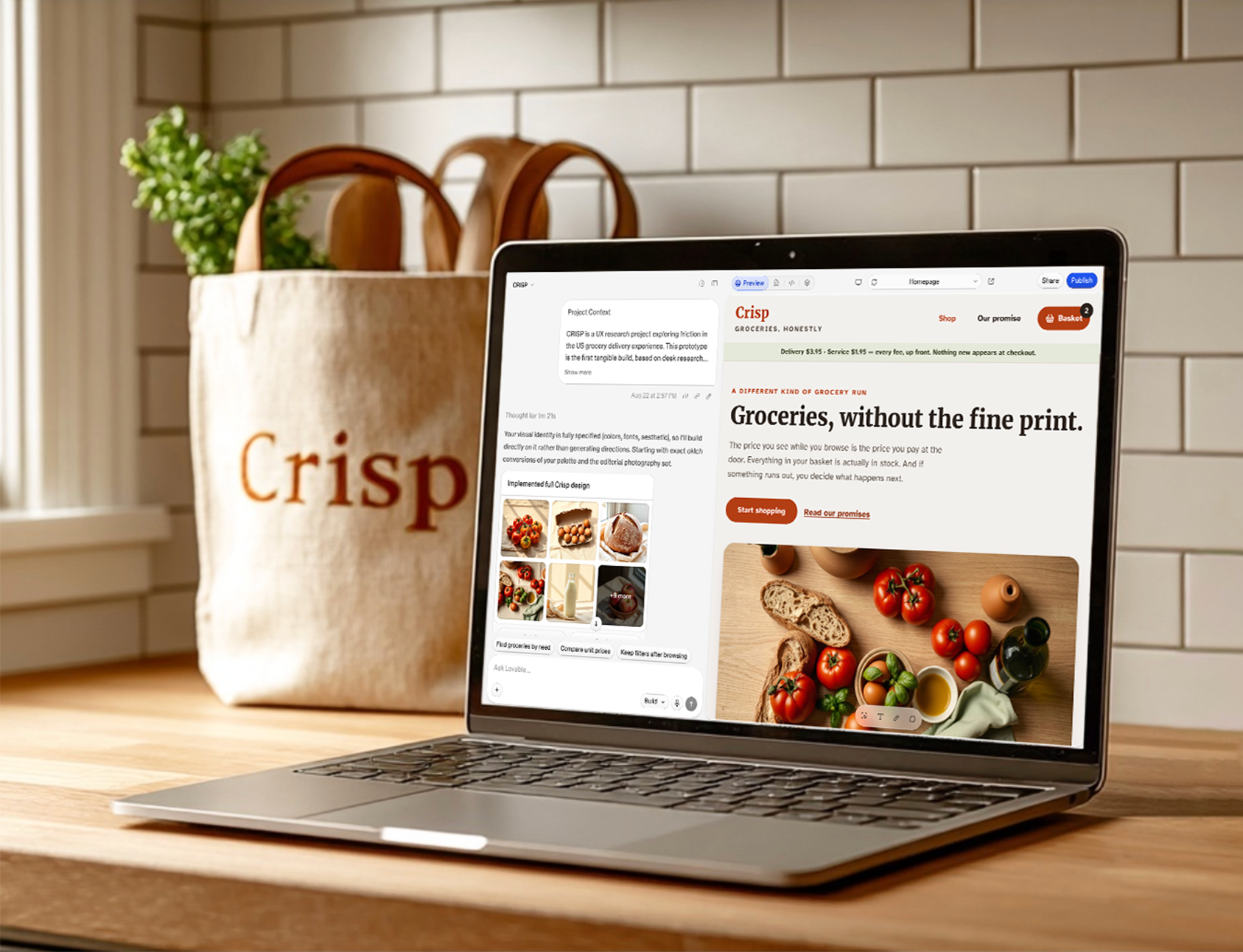
CRISP
A design log of how I work with AI, with grocery delivery as the test case
9 . 2 . 2026
Title has changed three times as the framing sharpened: from “CRISP: Grocery delivery built around trust, not pressure” (assumed a problem before research confirmed one), to “Missed Opportunities in Grocery Delivery?” (designing for a need, not a demographic), to “CRISP: Inclusive grocery delivery that leads with value and trust” (the product framing), to the current title. The focus is the workflow; the product is the artifact.
This is not a case study. It’s a dated design log of my workflow as it happened, with reflections added in retrospect.
About the project
How this became a design log
CRISP started as a regular case study. As an accessibility advocate, I set out to design a grocery delivery app for seniors. But as the work progressed, I noticed I was working in a very different way than I usually do, with AI involved at almost every step. That new workflow became the most interesting part of the project, and something I was doing for the first time. So instead of a traditional case study (research, prototyping, testing), I shifted to documenting the workflow itself.
The AI partnership
Claude and Gemini served as strategy and design partners, NotebookLM supported research, and Lovable handled the build. The partnership is the subject of this project; grocery delivery is the test case. Pushback went both ways, and the final decisions were mine.
The following is the unedited, dated record of that process — every pivot, every correction, every wrong turn, left in rather than cleaned up after the fact.
01/ VISION & DEFINITIONClaude, Gemini — strategy
FOCUS: EXPERIENCE LOGIC & CONSTRAINTS
6 . 25 . 2026
Vision statement updated to reflect current product direction: age targeting removed, reverse curb-cut effect and elegant accessibility definitions refined.
Early notes on the experience
4 . 18 . 2026
I am building CRISP to restore trust and agency in the grocery delivery service for experienced adults by leading with value and respect. My mission is to embody 'elegant accessibility': the belief that by designing for specific human needs, we create a more intuitive, frictionless experience for everyone.
5 . 12 . 2026
CORRECTION
I am building CRISP to restore trust and agency in the grocery delivery service for experienced adults by leading with value and respect. The target is to embody 'the curb cut effect': the belief that by designing for specific human needs, we create a more intuitive, frictionless experience for everyone. The experience will embody ‘Elegant accessibility’ — my vision to steer away from the utility-like feel typical of digital products, aiming to serve aging users.
6 . 25 . 2026
I am building CRISP to restore trust and agency in grocery delivery by leading with value and respect. The experience is designed around the reverse curb-cut effect — designing for everyone so that no one, including the senior user CRISP was originally designed for, is singled out or left behind. CRISP embodies “elegant accessibility”: accessible design that distances itself from the utility feel typically associated with the term — an experience that feels editorial without intimidating, and inclusive so no one feels left out.
What CRISP is about
To maintain project focus, I began by hand-written notes describing the core experience principles that would govern every design decision that follows.
4 . 22 . 2026
Artifact 1.1 / Hand-written notes of CRISP core concepts
Articulating & stress-testing
Gemini and Claude have helped me develop a framework for articulating and stress-testing core principles.
4 . 24 . 2026
Artifact 1.3 / Stress-testing freedom in CRISP against the first-time user experience
Artifact 1.2 / What freedom means in CRISP
This process helped define the following six system constraints.
5 . 26 . 2026
System constraints
Trust — The system will request information only when strictly necessary and only after demonstrating value.
Agency — The system will never use dark patterns, urgency cues, or default selections that steer users toward a specific action against their will.
Freedom — The system will never penalize exploration: no dead ends, no confirmation anxiety, no irreversible actions without a clear reversible path.
Respect — The system will never use cluttered layouts, low-contrast interactions, or patronizing language like "Don't worry" or "It's easy!"
Invisible Service — The system will never surface AI as a feature. Personalization will manifest as calm accuracy, not a flashy announcement.
Curb-Cut Effect (applied in reverse) — Every accessibility decision will be evaluated for its benefit to all users, not just seniors.
The system “fails” if it stops delivering these values.
Working with AIGoal
I wanted to create a UX expert persona that could provide pushback supported by evidence, not just agree with everything I said. This involved a lot of prompting and requesting to save the prompts as part of the persona’s memory for this project.
Did my strategy work?
Yes, but only at the execution level. Gemini and Claude were genuinely useful in insisting on stress-testing key flows and building out a framework once a direction was set. But twice during this stage, I shifted the project direction — first from designing for seniors to designing for everyone, then from building an app at all to documenting this AI-human workflow as the actual subject of the project. Both times, the persona’s response was the same: agreement, then momentum in the new direction.
That’s not a knowledge gap I can fix by feeding it more UX research. No amount of domain expertise would have given me “stop building an app, document the process instead” — that reframe wasn’t a UX problem the persona could reason its way into. I had to step outside the project to ask what I wanted to do with it, which is a different kind of thinking than evaluating whether a flow holds up.
Moving forward
I will experiment with building a persona that can flag higher-level decisions— a prompt to pause and interrogate “why now, why this” before building on the new direction, rather than moving straight to execution.
The purpose isn’t to give up my role as the decision maker, but to have a collaborator that pushes me to reassess every decision I make.
02/ RESEARCHNoteBook LM, Claude — research
Research ran in parallel with Vision and Definition from the start, not as a separate phase after them.
6 . 8 . 2026
In hindsight, quantitative context should have preceded qualitative research. Added retroactively
8 . 3 . 2026 -Note
Research findings will be updated to reflect pivot-2 in the research direction described below.
4 . 20 . 2026
The numbers
Only 12% of adults 55 and older shop for groceries online (USDA Economic Research Service, 2024) — and 64% of adults 50+ say technology is not designed with them in mind (AARP, 2024).
What the numbers mean
Desk research reveals a landscape of friction for older adults: mandatory account creation acting like a gatekeeper, intrusive data collection, and the noise of unsolicited recommendations.
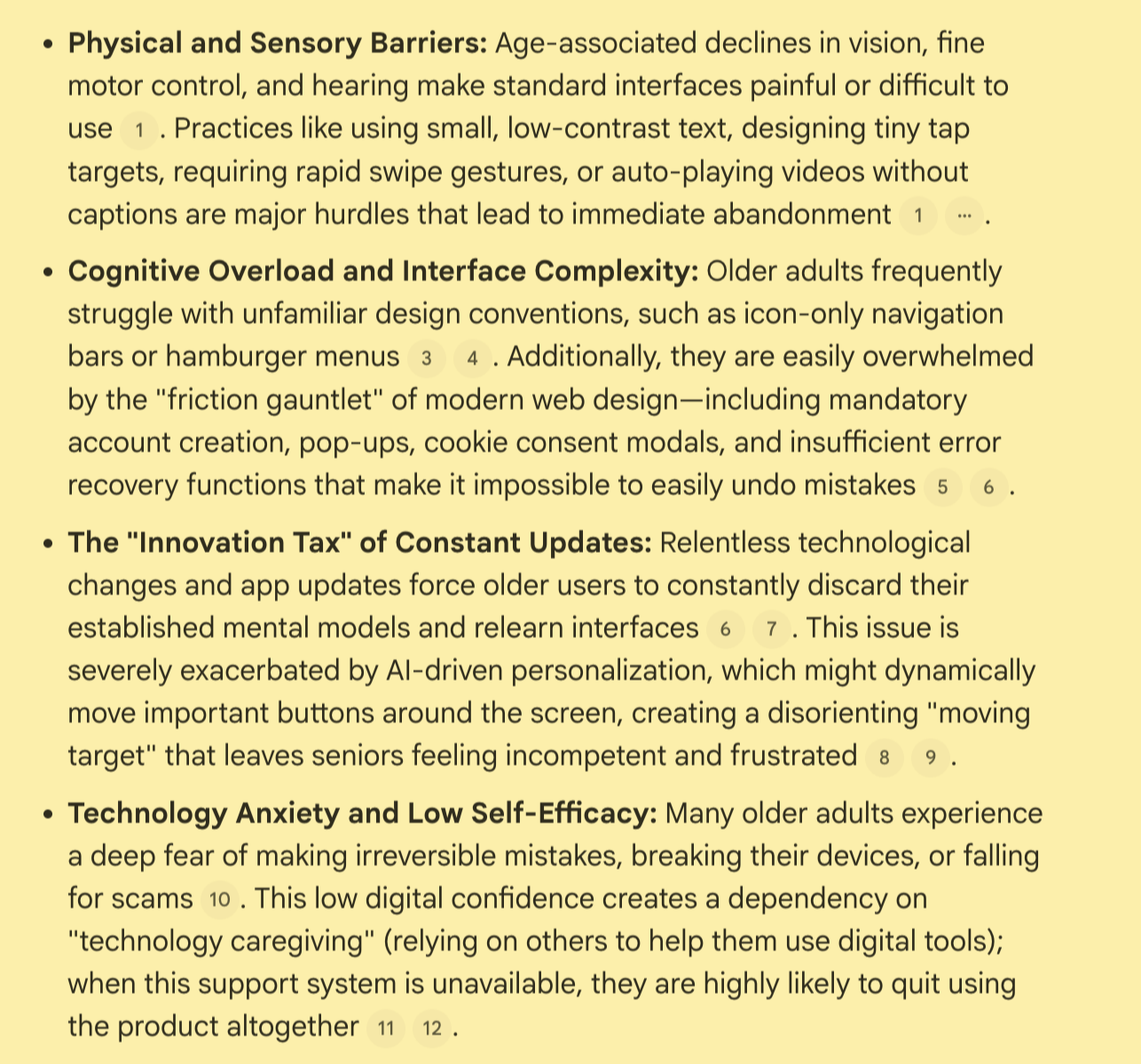
Artifact 2.1 / Aggregated research findings: usability, physical, and cognitive barriers
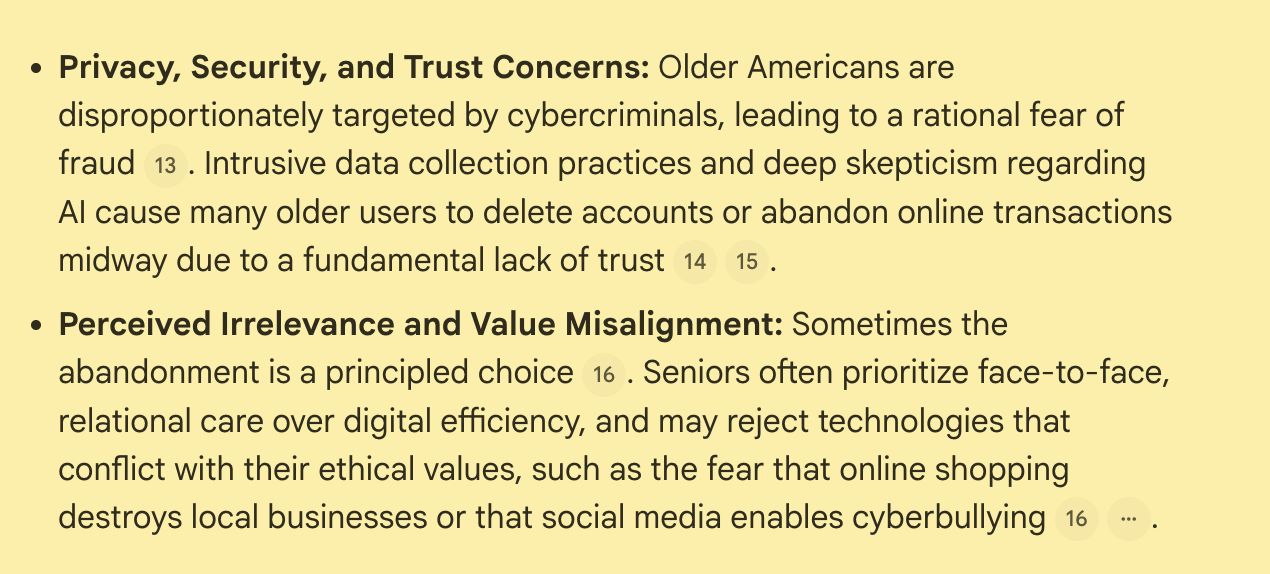
Artifact 2.2 / Aggregated research findings: trust and value alignment
7 . 21 . 2026
This research was conducted when the project was focused on older adults as the primary user group. It informed early assumptions about adoption barriers. Those assumptions were later challenged by primary research.
Early interviews were conducted with non-users — people who do not use grocery delivery. The assumption was that non-adoption was a UX problem: that people weren't using the service because the experience was too difficult or untrustworthy.
These initial interviews suggested that this might not be the case: non-users aren't avoiding grocery delivery because the experience is broken. For most, the need simply isn't there. Grocery shopping is social, habitual, and intentional — not a problem waiting to be solved by an app. This is an initial impression that needs further validation as more interviews are conducted.
If this finding holds, it will rule out designing for conversion. I will not try to persuade someone that they need something they don't need — I am a designer, not a marketing person. This raised a more fundamental question: am I designing for a demographic or a need?
The research focus has shifted to current users — people who already choose grocery delivery — to find out whether there are real missed opportunities in the experience. If there are, CRISP will respond to them. If there aren't, that's a valid and honest conclusion.
It is worth noting, though, that improving the experience for current users may naturally lower barriers for new ones — though this is not the design objective.
Research Pivot 1
Research Pivot 2
8 . 3 . 2026
I made a few shifts in the research focus. I realized that while I am asking relevant questions, I am missing the core ones.
This is the modified research path:
Focus on users first instead of non-users
“Why do seniors avoid grocery delivery services?” →“If seniors are not the primary users, let’s find out who they are and what issues, if any, they have with the experience?”.
Ask more specific questions
“Why do seniors avoid digital experiences?” →“What issues do seniors have with grocery delivery services?”
Track common frustrations across primary and secondary users
Include non-users in the interviews; the input of someone who avoids an experience adds an extra layer of understanding of that experience.
Research Update
8 . 6 . 2026
Who uses grocery delivery?
Raw data - NotebookLM-generated
The table below compares the habits and preferences of primary users (Gen Z & Millennials) vs secondary users (older shoppers 50+/60+) across multiple dimensions, e.g., adoption drivers, device preference, and accessibility.
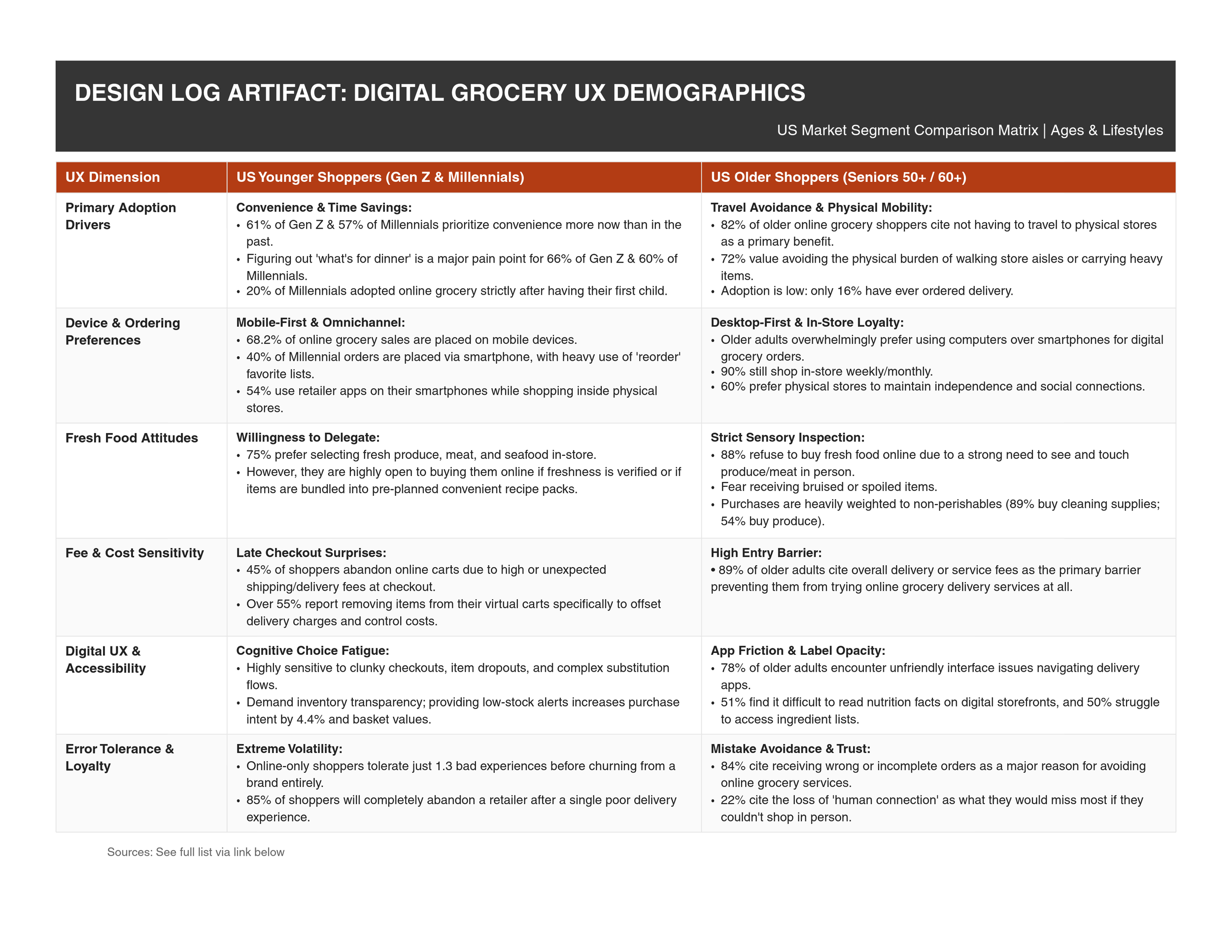
Artifact 2.3 / NotebookLM-generated comparison table of US digital grocery shopping by demographics
8 . 7 . 2026
What are the frustrations of grocery e-shoppers?
Raw data - NotebookLM-generated
This table focuses on the pain points of primary users vs secondary users.
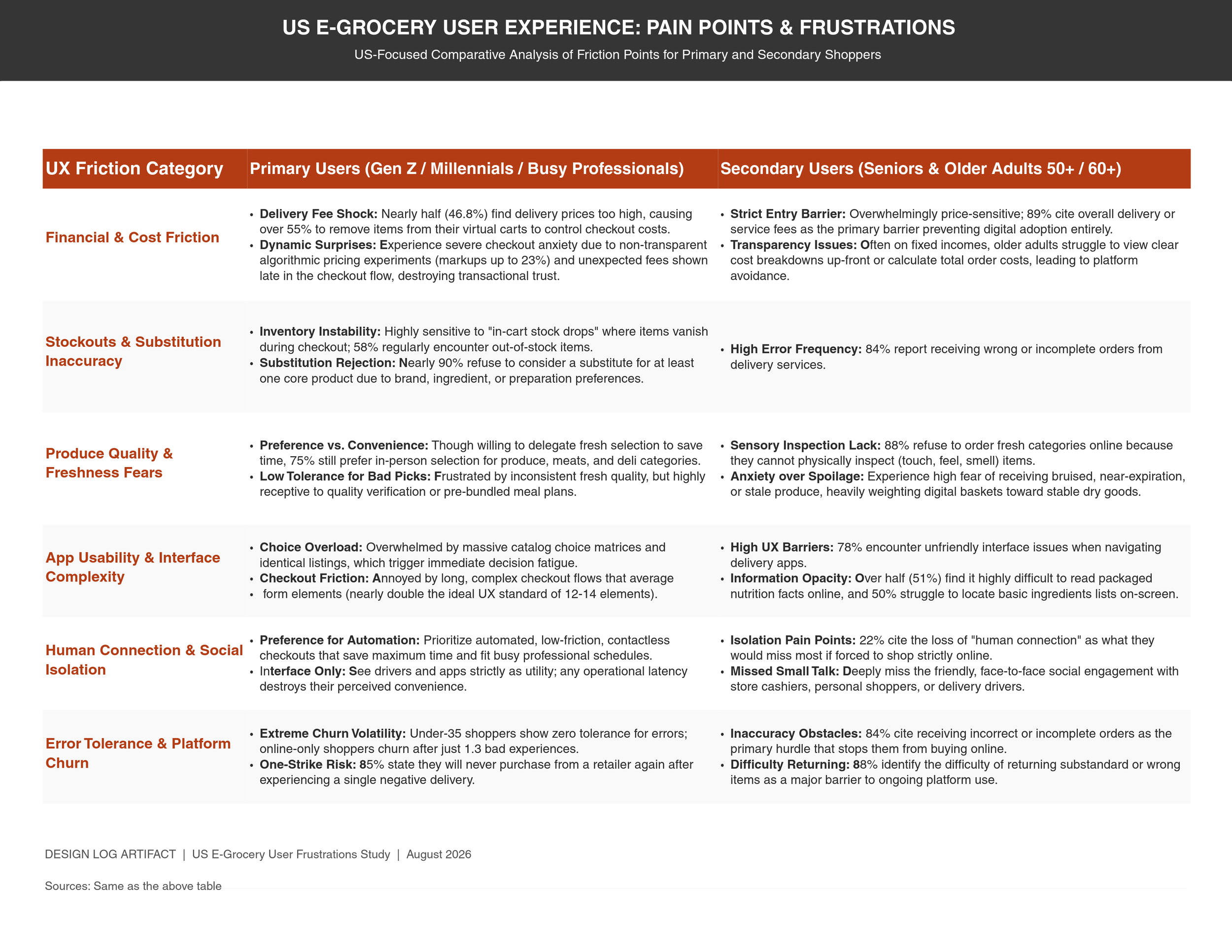
Artifact 2.4 / NotebookLM-generated comparison table of US digital grocery shoppers’ frustration by demographics
Up Next
8 . 7 . 2026
Continue interviews to validate research findings
Find creative ways to secure interviews, since I got a 0% response rate in the second round of outreach after the initial one
5 . 11 . 2026
— Potential candidates identified
Neighbors 60+
Local senior center visitors
My Pilates buddies who are 60+
6 . 3 . 2026
— Process began
6 . 8 . 2026
— Dual track revision
6 . 18 . 2026
— Routing question
— Interview intro added
—Frequency question moved from screening to user track; 'never' option removed to avoid contradiction with routing logic.
6 . 29 . 2026
— Taking a 3-week break. Resuming 7 . 22 . 2026
Interview prep & process
Initial interview questions assumed grocery delivery usage. Desk research (USDA ERS, 2024) shows only 12% of adults 55+ shop for groceries online — making non-users the statistically dominant profile. I revised the interview guide to a dual-track structure: one track for non-users exploring barriers and conditions for adoption, and the other track for users exploring their experience and satisfaction. A dedicated routing question was added to the screening process to determine which track applies to each participant before the interview begins.
-
Thank you for your time. Before we start, why don't you tell me a bit about yourself — what your day-to-day looks like, so I have some context.
-
5 . 10. 2026
How often do you use grocery delivery services?
Never
1 - 3 times/month
4 or more times/month
Only respondents who use it 4 or more times/month will be interview candidates. Familiarity with the experience is a key factor for the credibility of the replies.
5 . 11. 2026
How old are you?
60 — 70
71 — 80
Over 80
Almost missed that one! I have been internalizing the age factor the whole time that I forgot to explicitly mention it.
All respondents in these ranges are interview candidates. The granular brackets are intentional — the needs and friction points of a 62-year-old may differ significantly from those of an 82-year-old. CRISP is designed to serve the full spectrum of senior experience.
6 . 15 . 2026 — age question removed
The age question is irrelevant now since I will apply the “reverse curb-cut effect”. If I am designing for everyone, age should not be a screening question, but simply part of the interview intro questions.
6 . 15 . 2026 — frequency of use reframed
Frequency of use will be the only screening criterion, but in this case it’s not about letting people in or out, but about ensuring a balanced pool of participants.
6 . 18 . 2026
Routing question (asked first): How do you currently handle grocery shopping? → If exclusively in-store: continue to non-user track. Otherwise, continue to the user track.
-
How do you currently manage grocery shopping?
How would you describe your current grocery shopping experience — what works well and what doesn't?
Why didn’t you try grocery delivery?
What would need to be true for you to consider trying it?
Are you using any other delivery service, like food delivery or Amazon?
What makes you use these services?
If there is one thing you could change about these services, what would it be?
-
How often do you use grocery delivery services?
1—3 times/month
4 or more times/month
Frequent users (4+ times/month) provide credibility through familiarity. Occasional users (1—3 times/month) may reveal why commitment is hard to sustain. Non-users may reveal the barriers that prevented adoption altogether. All three perspectives are valuable to CRISP.
Initially, I was going to consider only frequent users — that would have been a missed opportunity.
What made you start using grocery delivery?
How would you describe your current grocery delivery experience to someone who has never used that service before?
What do you like most about the service you use? What frustrates you? Could you elaborate on why you feel that way?
Were you using a different one in the past? Which one? What made you stop using it?
What would make you switch to another service? Why?
If there is a “dream grocery delivery service,” what do you expect out of it? (updated 5 . 31 . 2026)
How does the service you are currently using make you feel? Why do you feel that way?
The emotional question is intentionally last — respondents reflect on their feelings after articulating opinions, not before.
7 . 22 . 2026
Interviews will resume with both current users and non-users. The goal is to validate whether "no need" is the dominant barrier to adoption, or whether other factors — such as cost or friction in the experience — also play a role. Findings will determine the project direction.
8 . 22 . 2026
Recruitment has brought 0% response.
Up Next
Pivot 3
8 . 22 . 2026
Given the 0% response rate from the interview candidates, and to keep the project moving, I will pivot to a build-first strategy. This means I will prototype with Lovable, then test the experience with real users.
Working with AIThe process
Research involved taking advantage of NotebookLM’s speed in gathering a huge amount of data, plus utilizing Claude to fact-check the data.
Did it work?
Yes, for the most part. The key was to accurately phrase the questions to capture the relevant data: “Who shops online?” covers a different scope from “Who shops for groceries online?”
The issue, however, was that asking Claude to double-check all the sources that NotebookLM cited slowed down the process a bit, and having to step in myself whenever Claude flagged something as uncertain added to the slowness.
Moving forward
Moving forward
The process worked for me since this was an exploratory project and time wasn’t an issue. It was still a clear step up from manually checking everything myself — the slowdown was narrow, only kicking in when Claude flagged something as uncertain. Moving forward, I’d want a framework that resolves those flagged discrepancies automatically, so I’m not the fallback every time.
03/ VISUAL LANGUAGEGemini, Claude — visual direction
FOCUS: VISUAL DESIGN DECISIONS EXPLAINED
6. 16. 2026
Table removed
The visual translation table attempted to predict how pillars would manifest visually before any screens existed. That mapping is redundant with the pillar definitions themselves, and the real translation will become visible through the actual build process.
Removed in favor of letting visual decisions emerge and be documented as they're made.
5 . 13 . 2026
— Typeface selection process started
5 . 26 . 2026
— WHY column added to document the reasoning behind each verdict.
6 . 1 . 2026
— Verdict system refined: legibility and aesthetic fit are now evaluated and displayed separately.
— Lexend's legibility verdict corrected from 'partial pass' to 'fail' — the I/1 distinction issue is an unacceptable risk in a grocery context where quantities and prices must be unambiguous.
— Upon closer examination, Radio Canada fails the legibility test — the capital I and numeral 1 are not sufficiently distinct for senior users.
— Atkinson's aesthetic assessment updated: while functionally strong, it does not quite meet CRISP's premium feel requirement.
6 . 2 . 2026
— Serifs were explored for their ability to evoke elegance, authority, and trust — core values in CRISP. However, none of the candidates passed the legibility test.
— Lora, Source Serif 4, and Merriweather passed the aesthetic fit, with the latter showing the most promise.
—Merriweather may be considered for headings only, where larger sizes reduce the risk of ambiguity.
—Decision pending.
6 . 8 . 2026
Typeface decision: Merriweather for headers + Atkinsons Hyperlegible for body.
Translating experience pillars into visual decisions
5 . 6 . 2026
Mapping the 6 constraints (trust, agency, freedom, respect, invisible service & reverse curb-side effect) to a visual execution strategy is the first step.
Note: The table below will be updated to reflect the revised constraints and typeface findings.
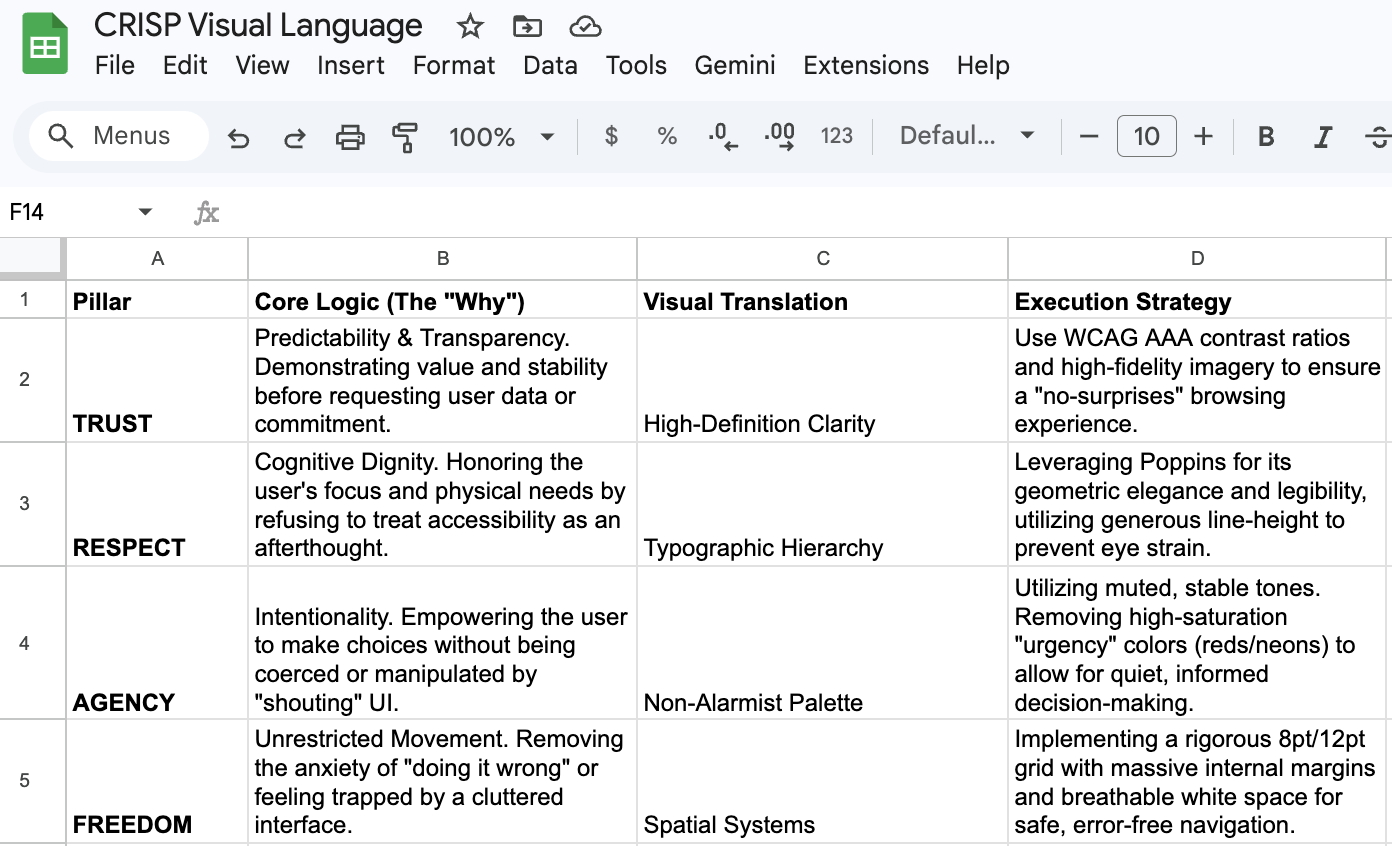
REMOVED
Artifact 3.1 / Initial visual language audit with Gemini
5 . 13 . 2026
Typeface selection process
Accessibility is the non-negotiable starting point. The question then became: which typefaces pass a rigorous legibility test and carry the premium feel CRISP's users deserve.
5 . 26 . 2026
Testing letter legibility and typeface aesthetic fit
Non-serif candidates
The first three candidates — Lexend, Atkinson Hyperlegible, and Radio Canada — emerged from research into the most legible typefaces for low-vision and aging users. Poppins was introduced as a contrast test: a widely used, character-rich font to see if aesthetic appeal could compensate for lower legibility. It couldn't.
Artifact 3.2 / LlI1 letter legibility test — Lexend, Atkinson Hyperlegible, and Radio Canada pass; Poppins fails
Artifact 3.3 (Updated 6.1 .2026) / LlI1 letter legibility test — revised verdicts with separate legibility and aesthetic fit criteria; Radio Canada and Atkinson assessments updated.
Serif candidates
Serifs were explored as candidates and put through the same legibility test.
Artifact 3.4 (6.2.2026) / LlI1 letter legibility test — serif candidates evaluated against legibility and aesthetic fit criteria
Typeface decision
No single typeface passed both tests. Rather than continue the search, the decision was to let each font do what it does best: Merriweather for headers, where its editorial character shines at larger sizes; Atkinson Hyperlegible for body text and UI labels, where engineered legibility matters most. Together, they cover both criteria — elegantly.
Artifact 3.5 (6.8.2026) / Typeface pairing rationale — combining strengths to meet both legibility and aesthetic criteria
6 . 5 . 2026
Art direction criteria
Imagery in CRISP is not decorative — it is part of the respect constraint. How products look communicates how users are valued. Imagery should feel premium — and in CRISP, premium is defined by the following criteria:
Lighting: Natural, warm, directional sunlight — never flat or artificial
Composition: Editorial framing, generous negative space, details in focus
Color temperature: Warm, with soft shadows
Subject matter: Real-life items in a curated composition
Mood: Calm and refined — every element in the frame is intentional, nothing is excess
To maintain full control over these criteria, all imagery in CRISP will be created using AI image generation tools, with detailed prompts informed directly by this art direction.
Up Next
6 . 5 . 2026
Visual exploration — testing AI-generated imagery against the art direction criteria.
Spacing system
Color — pending interview findings, which may influence final decisions.
Working with AIA smooth collaboration
This was the smoothest collaboration of the project. I had a clear vision for how the experience should feel (calm and premium), and Claude helped me translate it into concrete visual elements, then into prompts for Lovable to generate the imagery.
What made it work?
As the project went on, I got better at communicating what I wanted. I used more precise language and specified how I wanted Claude to structure its replies. For example, instead of asking for a “premium feel,” I asked for “font combinations that look premium and legible, and that hold up at larger sizes.” I also asked it to skip long explanations of why something works, and to save its reasoning for when we disagreed, or when something didn’t work.
Moving forward
I’ll start each phase the way I started this one: with a clear point of view, not a rigid one. A clear starting point gives the discussion something to push against. A well-prompted, well-conditioned AI can then challenge it, sharpen it, or change it, and I make the final call.
04 / THE BUILD-FIRST PROCESS Lovable, Claude — build & critique
IN PROGRESS
8 . 26 . 2026
Since I am moving to a prototype-first approach, the project will shift to building CRISP, a grocery delivery app for a conceptual physical store carrying the same name. The app will aim to replicate the same familiarity, honesty, and trust the store has built in the neighborhood.
I asked Claude to take the above info and specs and turn them into a design brief that I can feed into Lovable and then consider Lovable’s first output as iteration #1.
I will share snapshots of the different iterations as they roll out, along with my critiques and how Lovable iterates accordingly.
Iteration #1
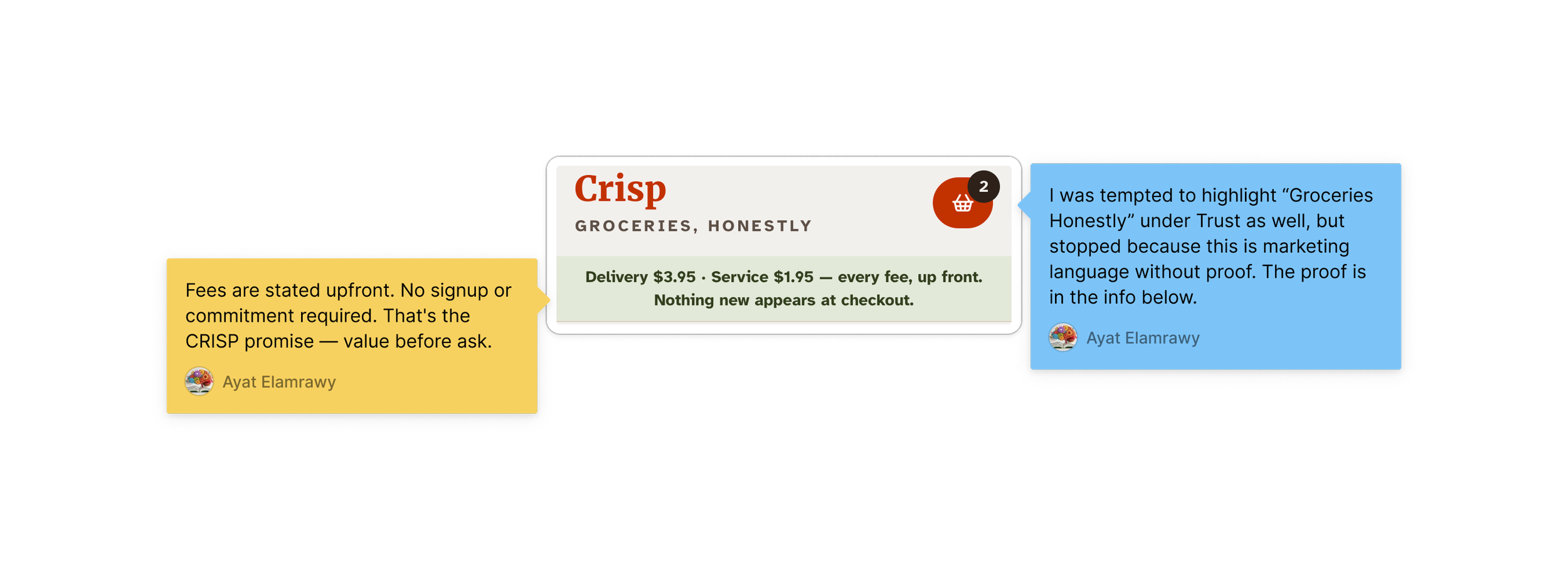
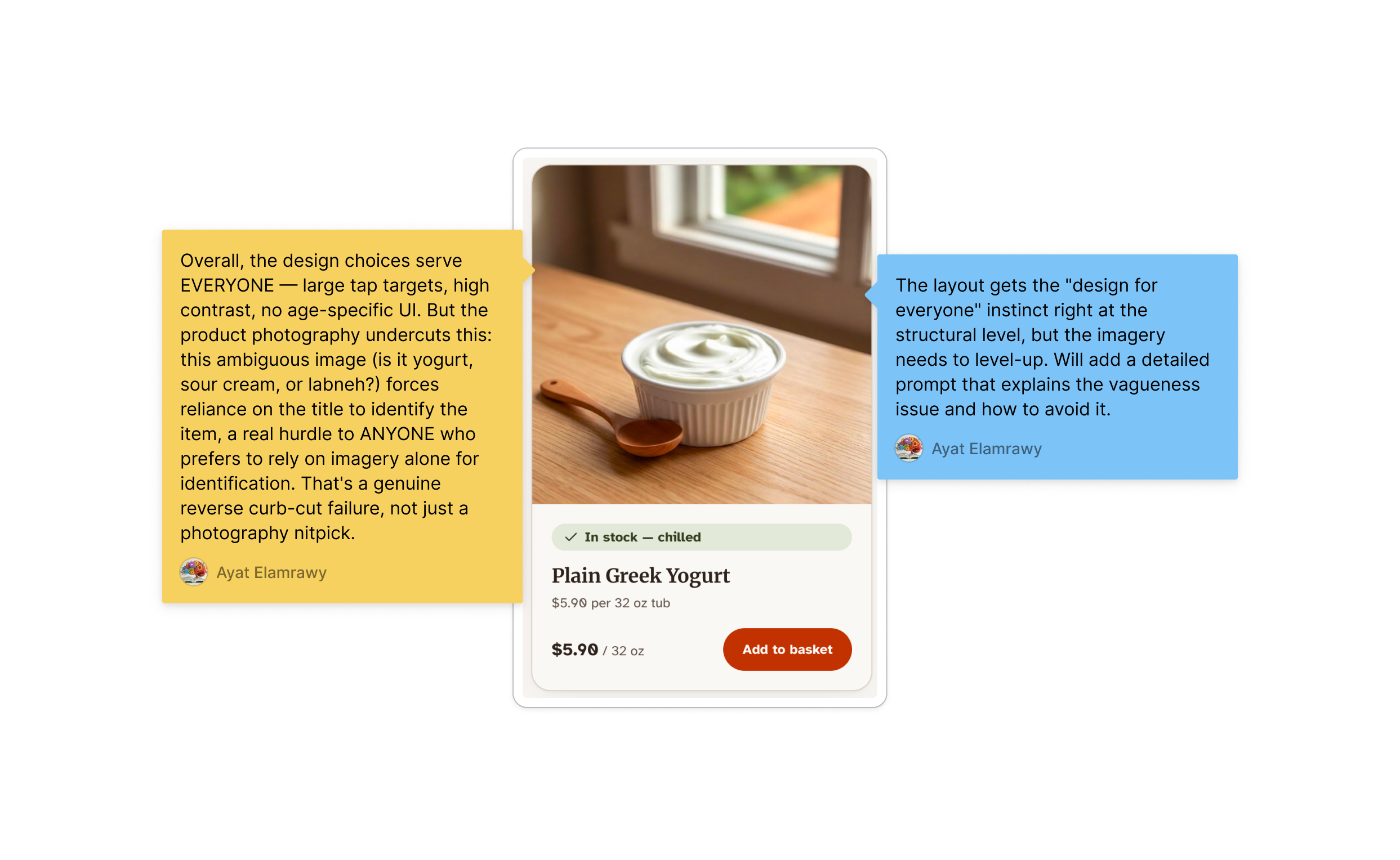
Initial homepage critique against the 6 system constraints (Trust, Agency, Freedom, Respect, Invisible Service, Reverse Curb-Cut Effect)
Yellow notes describe the issues; blue notes are reflections.
9 . 21. 2026
The homepage
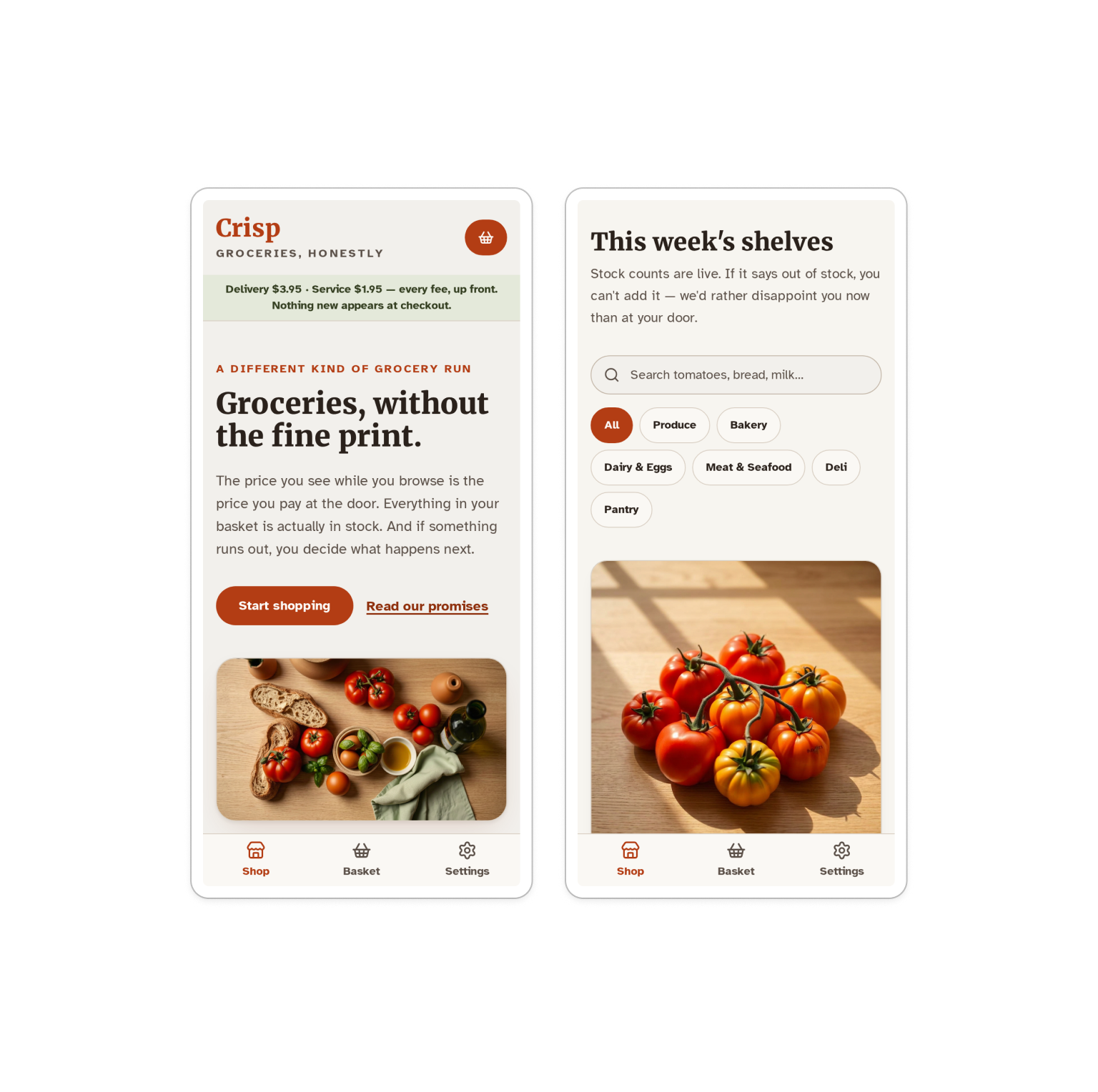
1- TRUST — Served
Provide value first, before any ask.
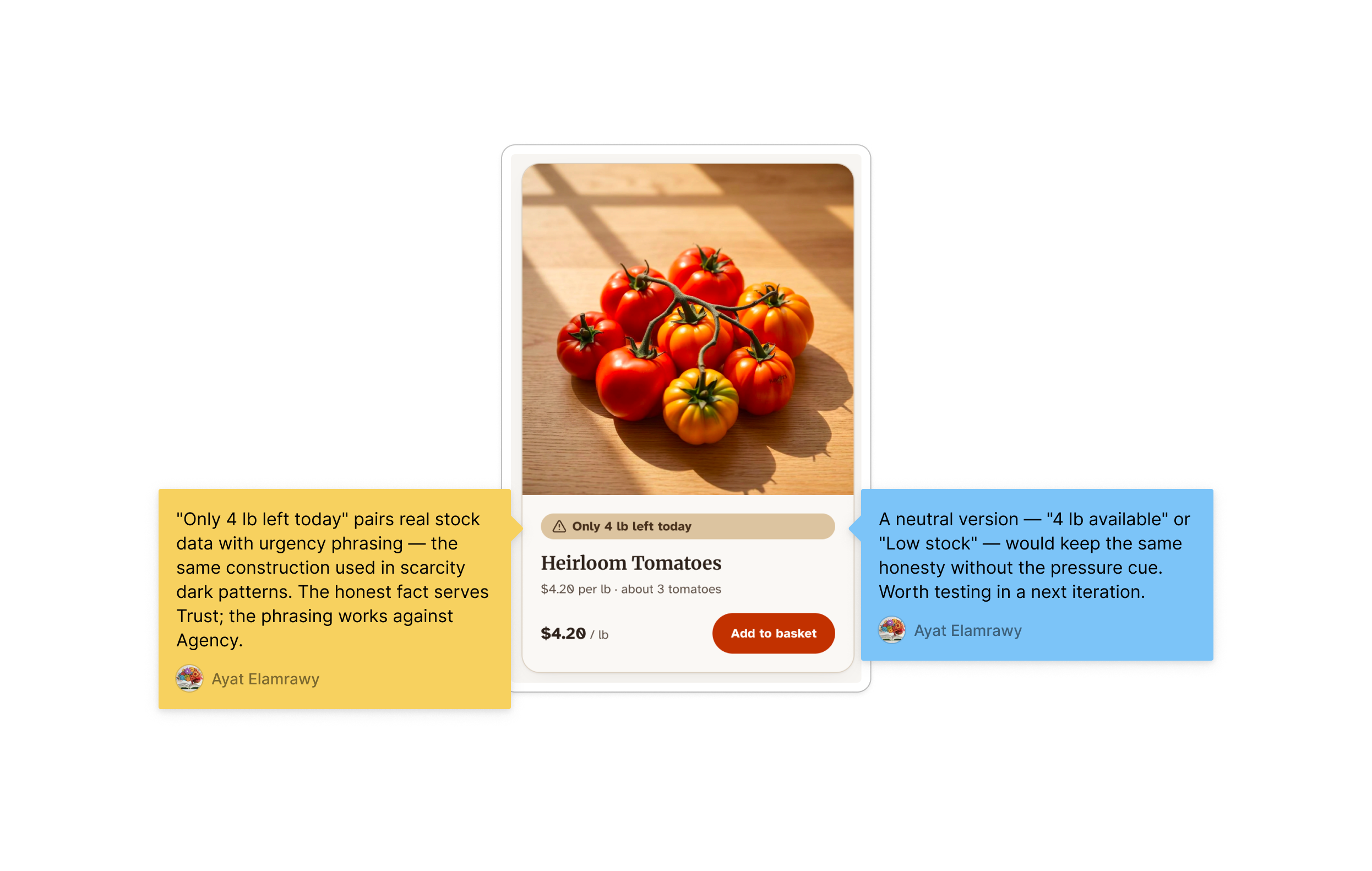
2- AGENCY — Mixed
No dark patterns, urgency cues, or steering defaults
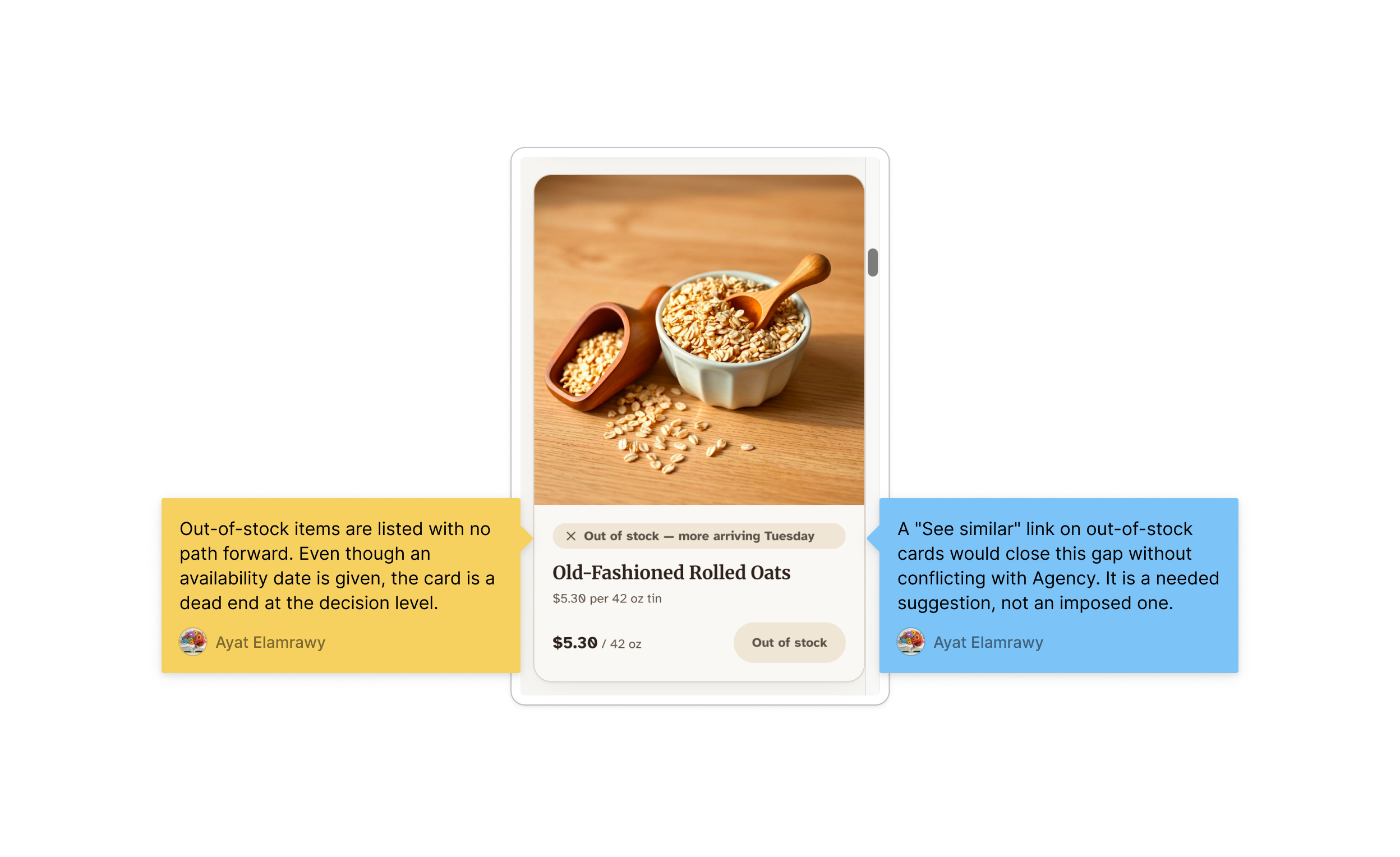
3- FREEDOM — Mixed
No dead ends, no confirmation anxiety, no irreversible actions without a clear reversible path.
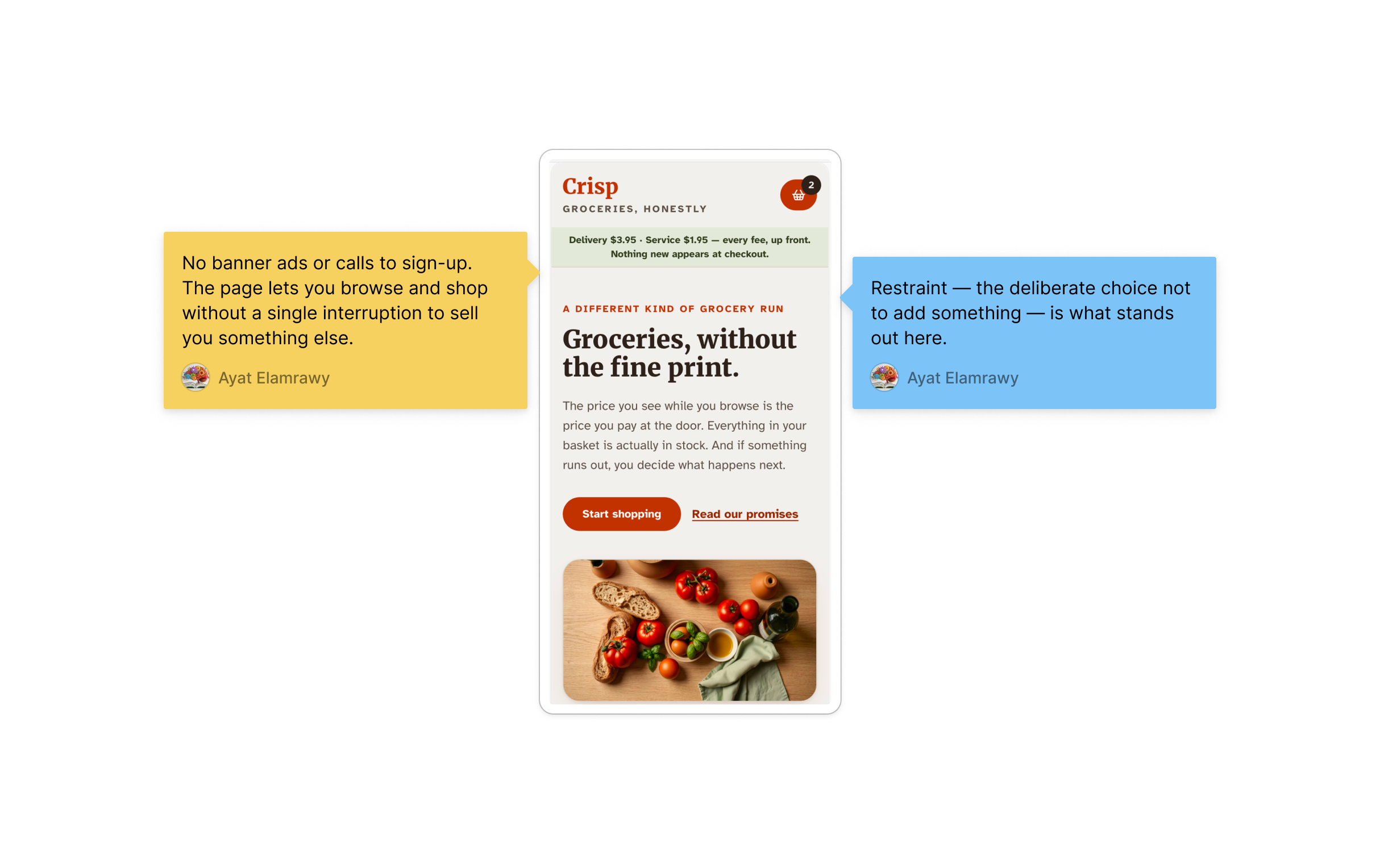
4- RESPECT — Served
No clutter, low-contrast interactions, or patronizing language.
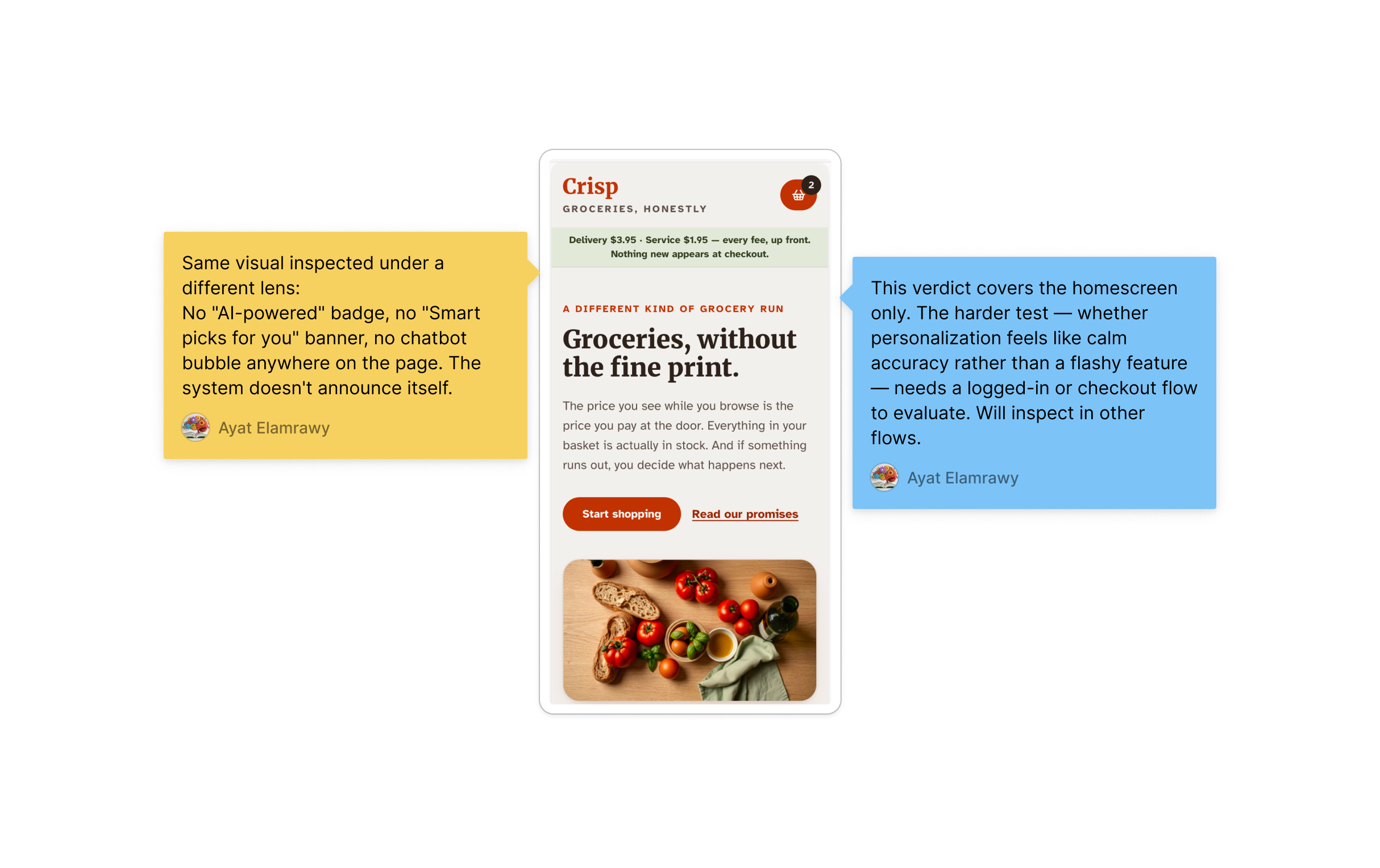
5- INVISIBLE SERVICE — Served on homescreen
AI doesn’t surface as a feature. Personalization reads as calm accuracy, not a gimmick.
6- CURB-CUT EFFECT REVERSED — Mixed
Every accessibility decision is evaluated for its benefit to ALL users.
Up Next
9 . 23 . 2026
Adding a “reflection” segment under each major section discussing what worked and what did not work in the AI collaboration, and what I learned from that.
Adding a final note on the project as a whole, reflecting on the new workflow and what I’d change moving forward.
Working with AIFast but faulty… or rather, default-y
The build was the fastest phase of the project. Claude helped me turn the concept into a design brief, and Lovable turned that brief into a working homepage in minutes. Seeing the experience on screen made it much easier to judge than an idea on paper.
Where it fell short
Even with a brief built around trust and respect, Lovable reached for familiar e-commerce patterns: urgency copy on a stock badge, and an out-of-stock message with no next step. Each one worked against the CRISP system constraints. The tool built what it had seen most often, not what the CRISP experience stood for.
I take responsibility for the vague imagery, though. The brief was not specific enough to rule out “an object that can be confused with others” and “multiple props around the main item.”
Moving forward
I’ll write the constraints into the brief as explicit rules instead of values — “no urgency copy,” “every dead end gets a next step,” “one clear subject per image” — and critique each iteration against all six constraints before writing the next prompt.
Closing note
CRISP started as a grocery delivery concept and became something else: a working test of how I design alongside AI. The grocery app was the artifact. The partnership was the subject.
What I learned
Across every phase, the same pattern held. The most useful collaborations started with me having a clear point of view and an AI prompted to push back on it. Sometimes my vision held, sometimes it shifted. What mattered was that the discussion made it better, and that the decision stayed mine.
When that structure was missing, the work drifted. During the vision phase, the UX persona I built executed well but didn’t flag high-level decisions before acting on them, so major direction shifts went unchallenged. In the build, every gap in my brief got filled with the most familiar pattern available, from urgency copy to cluttered imagery. The fix was always the same: be specific about what I want, give the AI a framework and permission to disagree.
Why I’m closing it here
CRISP set out to show how I work with AI across a full design process. It did. The last few rounds kept confirming the same lessons rather than teaching me new ones, which told me the log had done its job. More iterations would add length, not insight.
The one phase CRISP never reached was usability testing with real participants. That’s where I want to take this next: seeing how AI helps, and where it doesn’t, when the evidence comes from users instead of assumptions.